




B2B (Business-to-Business)
Consulting or software development contracts with other businesses.

B2G (Business-to-Government)
Engaging in government projects or research collaborations, especially in AI, robotics, or defense.

B2C (Business-to-Consumer)
Sale of consumer-centric AI software or applications, though less common in the Deeptech space.

Goods
Physical hardware associated with Deeptech typically attracts GST at the standard rate of 18%, depending on the specific classification of the item.

Software as a Service (SaaS)
Generally falls under 18% GST. SaaS is classified under HSN Code 997331 for the supply of online digital content.

R&D Services
May attract GST at 18%, particularly if classified under consulting or scientific and technical consulting services (HSN Code 9983).

Consultancy & Advisory Services
These also attract 18% GST, classified under 998313 for IT consultancy services.

ITC is not available for goods or services used for personal consumption.
ITC on capital goods (such as R&D equipment) may have restrictions if the goods are used partially for non-business purposes.

In cases where Deeptech startups engage in exempt or export services, certain ITC limitations may apply.

GST Registration
Mandatory if turnover exceeds Rs 20 lakhs (Rs 10 lakhs in special category states).

Returns Filing
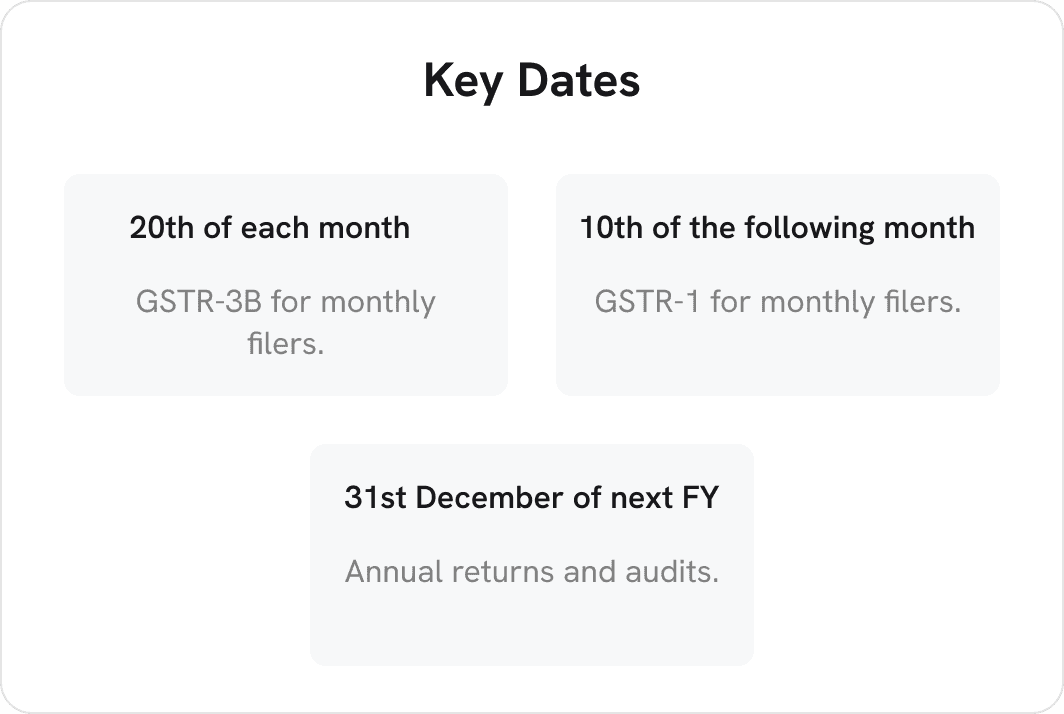
GSTR-1 (monthly or quarterly) for outward supplies. GSTR-3B (monthly) for summary returns and ITC claims. GSTR-9 (annual return) if turnover exceeds Rs 2 crores.

Audit Requirements
GST audit under GSTR-9C for businesses with annual turnover exceeding Rs 5 crores.

Reconciliation:
Matching of ITC as per GSTR-2A with books, to be done monthly or quarterly.

Late Filing
Rs 50 per day (Rs 20 for NIL returns), capped at Rs 5,000.

Non-Filing of Returns
Additional penalties for non-compliance and suspension of GST registration after repeated defaults.

Incorrect ITC Claims
Penalty up to 100% of tax amount if ITC is wrongly availed.
